
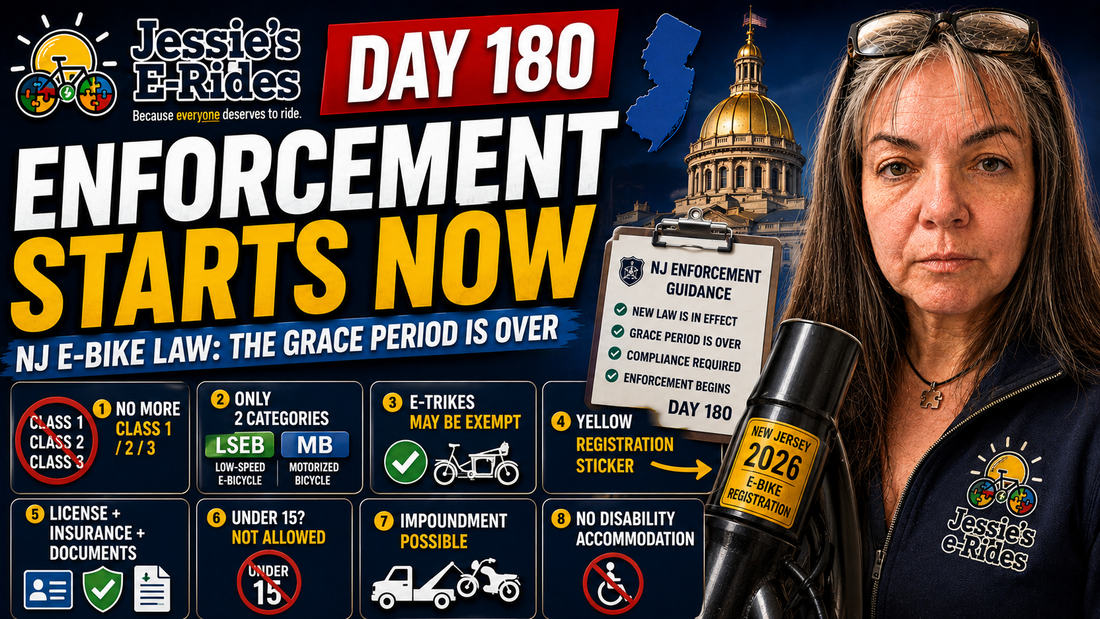

The NJ E-Bike Law: Day 180 – What Every New Jersey Rider Needs to Know After the Grace Period
Share
Today marks Day 180 since New Jersey's new e-bike law was signed, and the six-month grace period has officially ended.
Law enforcement agencies across the state have now received guidance through a white paper distributed to police departments explaining how officers should interpret and enforce the new law.
In today's update, we break down some of the most important information riders, parents, and e-bike owners should understand as enforcement begins.
The Class System Is Gone
One of the biggest changes is that New Jersey no longer recognizes the former Class 1, Class 2, and Class 3 e-bike system.
Instead, the law now recognizes only two primary categories:
- Low-Speed Electric Bicycles (LSEBs)
- Motorized Bicycles (MBs)
Many e-bikes that were previously sold as Class 2 or Class 3 models now fall under the motorized bicycle category, bringing new licensing, registration, and insurance requirements.
Important Clarification for E-Trikes
The guidance also states that many three-wheeled electric trikes do not fit the new statutory definitions.
As written, qualifying pedal-assist e-trikes under 750 watts with a top assisted speed of 20 mph fall outside the new registration and licensing framework, an important clarification for many riders who depend on e-trikes for transportation and mobility.
Passenger Rules Create New Questions
The white paper explains that passengers are permitted only when the bicycle is designed with permanent seating.
However, another section indicates that motorized bicycles may carry only the operator, creating new concerns for cargo bikes and passenger-capable e-bikes that were specifically designed to transport children or additional riders.
Registration Process Raises Concerns
The guidance explains that registration must generally be completed in person at a New Jersey MVC office using documentation such as a Manufacturer's Certificate of Origin (MCO), a notarized bill of sale, or a sworn affidavit.
However, many manufacturers do not routinely provide MCOs to customers, creating uncertainty for riders attempting to register their e-bikes.
The white paper also discusses concerns regarding stolen bicycles, VIN creation, and whether registrations using sworn affidavits will be automatically checked against national stolen property databases.
New Registration Stickers
Registered motorized bicycles will receive a permanent yellow registration sticker that is attached to both sides of the front fork.
The registration remains with the bicycle, similar to boat registrations, while ownership information is maintained within MVC records.
Licensing Requirements
The guidance confirms:
- Drivers with a valid New Jersey driver's license may operate qualifying e-bikes up to 28 mph.
- E-bikes capable of speeds above 28 mph are treated as motorcycles and require a motorcycle endorsement.
- Riders ages 15 and 16 cannot legally operate motorcycles because they are not eligible for a motorcycle endorsement.
Violations Now Being Enforced
With the grace period over, officers may issue citations for violations including:
- Failure to provide required documents
- Operating an unregistered e-bike
- Operating without the required license
- Operating without required liability insurance
Parents should also note that children under age 15 are prohibited from operating any e-bike on public roads under the new law.
Parental Responsibility
The white paper states that parents or guardians may face civil or statutory liability if they knowingly allow an underage or unlicensed child to operate an e-bike.
Questions regarding possible criminal liability remain unresolved and may ultimately require guidance from prosecutors or the Attorney General.
Impoundment May Be Possible
Although the statute does not require mandatory towing, the guidance explains that many police departments may impound an uninsured, unregistered, or unlawfully operated e-bike if it cannot legally remain on the roadway.
Departments may allow owners to arrange a private tow depending on local policy.
DWI and Criminal Offenses
The document also explains that motorized bicycle operators may be charged with driving while intoxicated under existing New Jersey law.
In addition, riders who recklessly injure others may face criminal charges including reckless endangerment, assault, or assault by auto depending on the circumstances.
E-Scooters Remain Different
The guidance confirms that qualifying low-speed electric scooters with a maximum speed of 19 mph remain exempt from registration, licensing, and insurance requirements, provided they meet the statutory definition.
Insurance and Equipment Requirements
The white paper discusses minimum liability insurance requirements and notes that companies such as Velosurance offer policies exceeding New Jersey's required minimum coverage.
It also reviews equipment requirements, including lights, brakes, horns or bells, and DOT-approved helmets. Rearview mirrors are not specifically listed as mandatory equipment for motorized bicycles.
Unanswered Questions Remain
While the white paper answers many enforcement questions, it also leaves several issues unresolved.
Among the biggest concerns is the continued lack of accommodations for riders with disabilities who cannot obtain a driver's license through the standard licensing process. The guidance does not address how those individuals will legally continue using their e-bikes for transportation.
As enforcement begins across New Jersey, additional clarification and legislative changes may still be necessary as real-world situations continue to emerge.
📂 This update is part of our ongoing NJ E-Bike Law series.
Follow all updates here:
NJ E-Bike Law Playlist on YouTube
📺 Watch the full Day 180 update here:
 Shrewsbury, NJ
 855-88JESSE (855-885-3773)
 hello@jesseserides.com
