
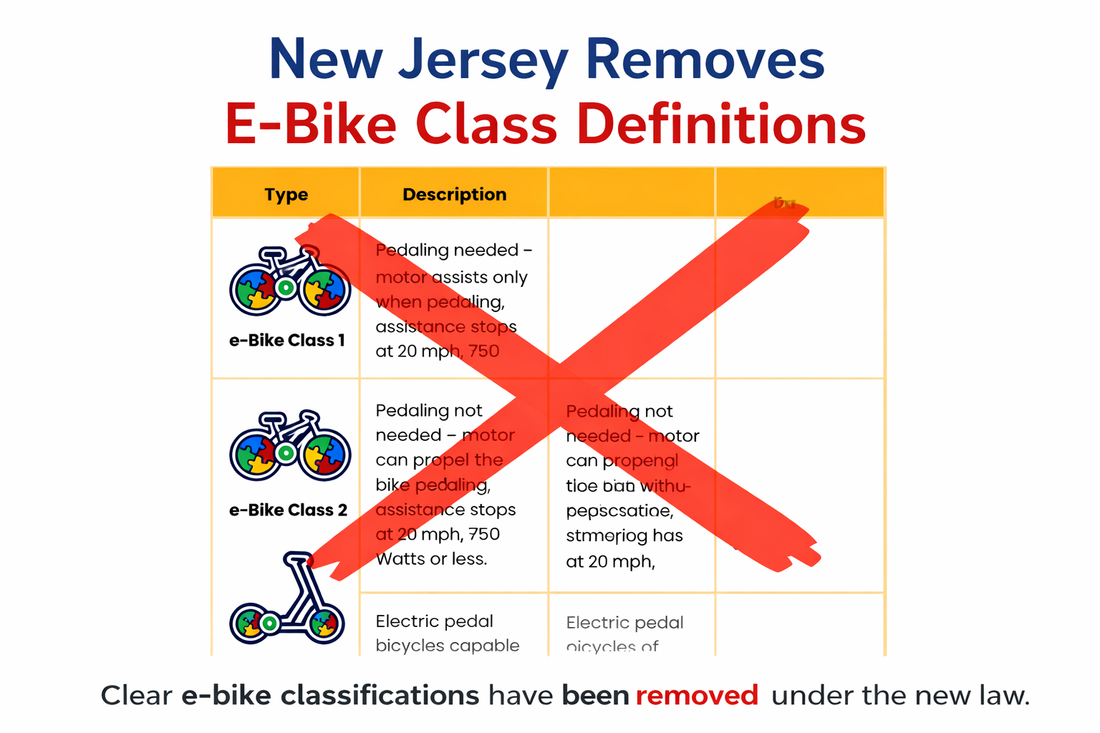

The NJ E-Bike Law: Day 12 – What We Lost When Class Definitions Disappeared
Share
Today’s update focuses on something many riders may not fully realize they’ve lost with New Jersey’s new e-bike law: clear, functional class definitions.
Before the law changed, e-bikes were grouped into Class 1, Class 2, and Class 3 categories. Those distinctions mattered, and they helped riders, retailers, and law enforcement understand how different bikes were intended to be used.
What a Class 1 E-Bike Is
A Class 1 e-bike is pedal-assist only. That means the motor engages only when you are pedaling. There is no throttle, no twist grip, and no thumb control.
It’s important to note that the class has nothing to do with the size or appearance of the bike. The classification is based entirely on how the motor functions.
How Class 2 Bikes Worked
Most e-bikes traditionally sold fall into the Class 2 category. These bikes include a throttle, allowing the rider to engage the motor without pedaling.
Class 2 e-bikes are limited to a top assisted speed of 20 miles per hour. One way to identify them is by the presence of a throttle or by the classification sticker placed on the bike by the manufacturer.
What Changed When a Bike Became Class 3
Many Class 2 bikes can be unlocked to become Class 3. When that happens, the bike may look the same, but the motor assistance increases to a maximum of 28 miles per hour.
Manufacturers typically provide updated classification stickers, and riders are expected to relabel the bike accordingly. While not everyone does this consistently, the key defining feature of a Class 3 e-bike is that motor assistance cuts off at 28 miles per hour.
Why These Distinctions Mattered
These classifications created clarity. They helped set expectations around speed, use, and regulation. They also allowed lawmakers to regulate responsibly without overreaching.
With the new law eliminating these distinctions, very different types of bikes are now treated the same under the law — despite having very different designs, capabilities, and intended uses.
What This Means Going Forward
The loss of clear class definitions is one of the biggest practical problems with the current legislation. Without them, it becomes harder to regulate fairly and easier to create unintended consequences.
This is another area where thoughtful amendments and clearer language could make a meaningful difference.
I’ll continue to highlight these real-world examples as conversations with lawmakers move forward.
📂 This update is part of our ongoing NJ E-Bike Law series.
Follow all updates here:
NJ E-Bike Law Playlist on YouTube
📺 Watch the full Day 12 update here:
 Shrewsbury, NJ
 855-88JESSE (855-885-3773)
 hello@jesseserides.com
