

The NJ E-Bike Law: Day 89 – The Problem Is Confusion, Not E-Bikes
Share
Today marks Day 89 since the New Jersey e-bike law was signed.
There is a fundamental problem driving this entire situation:
Most people do not actually know what an e-bike is.
A large number of comments supporting the law point to reckless behavior, kids riding dangerously, and unsafe vehicles on the road.
But in many of these cases, what people are describing are not e-bikes.
They are e-motos.
The Source of the Confusion
An op-ed by Bob Mittelstaedt in Streetsblog USA highlights this issue directly.
The article examines the incident in Scotch Plains that helped trigger the current e-bike legislation.
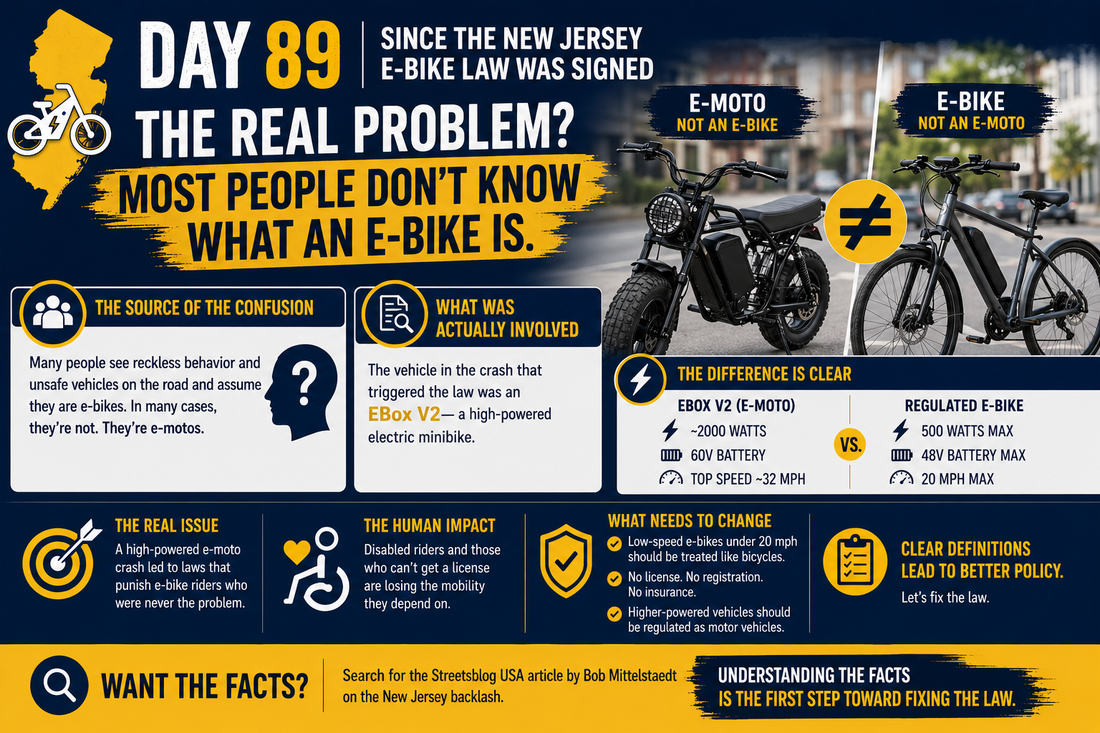
Through public records requests and analysis, the vehicle involved was identified as an EBox V2.
This is not a low-speed, regulated e-bike.
It is a high-powered electric minibike.
What Was Actually Involved
The EBox V2 has specifications that clearly place it outside the definition of a street-legal e-bike:
- Approximately 2000 watts of power
- 60-volt battery system
- Top speeds around 32 mph
By comparison, regulated e-bikes are limited to much lower power and speed thresholds.
This distinction is critical.
The Real Issue
The crash that sparked widespread concern involved a high-powered e-moto, not a regulated e-bike.
That difference matters when writing policy.
When categories are misunderstood, legislation can end up targeting the wrong group.
In this case, the response created restrictions that impact people who were never the source of the problem.
The Human Impact
This is not just about definitions.
It is about real people.
Disabled riders who rely on e-trikes for independence are now facing barriers that did not exist before.
Individuals who cannot obtain a driver’s license are losing access to mobility they depend on for everyday life.
These are consequences that stem directly from misclassification.
What Needs to Change
The path forward is clear.
Low-speed e-bikes under 20 mph should be treated like bicycles and not require licensing, registration, or insurance.
Higher-powered vehicles should be regulated appropriately as motor vehicles.
Clear definitions lead to better policy.
Verify the Information
If you want to explore the reporting behind this issue, you can search for the Streetsblog article by Bob Mittelstaedt discussing the New Jersey backlash.
Understanding the facts is the first step toward fixing the law.
📂 This update is part of our ongoing NJ E-Bike Law series.
Follow all updates here:
NJ E-Bike Law Playlist on YouTube
📺 Watch the full Day 89 update here:
 Shrewsbury, NJ
 855-88JESSE (855-885-3773)
 hello@jesseserides.com
